When it comes to MOTs, tyre issues are one of the most common reasons for failure. From excessive wear and tear to visible damage affecting tread or sidewalls, tyres that don’t meet legal standards could result in an automatic fail.
In this blog, we’ll explore the key tyre-related issues that could cause a vehicle to fail its MOT, why they matter, and how to prevent them.
We’ll also explain how Tyreweld can help you out in an emergency!
What are MOT tyre regulations?
Tyres play a critical role in vehicle safety, which is why they are a key focus during an MOT. The UK’s MOT tyre rules state that all tyres must be in good condition, properly fitted, and have sufficient tread depth. Failure to meet these criteria can lead to an MOT tyre failure.
If your vehicle has a Tyre Pressure Monitoring System (TPMS) fitted as standard, it must be fully functional, even if it’s telling you that your tyres are underinflated when they aren’t.
Additionally, all tyres must be the correct size and type for the vehicle. If any of these criteria are not met, the car will fail its MOT.
Reasons why your car tyres might cause MOT failure
Now that we know how important tyres are in passing an MOT, let’s take a look at some of the reasons they might cause your car to fail.
1. Tread depth
Tyre tread is essential for maintaining grip on the road, especially in wet or slippery conditions because water cannot be channelled away from the tyre quicker enough. If the tread is too low, stopping distances increase, and the risk of skidding or losing control rises.

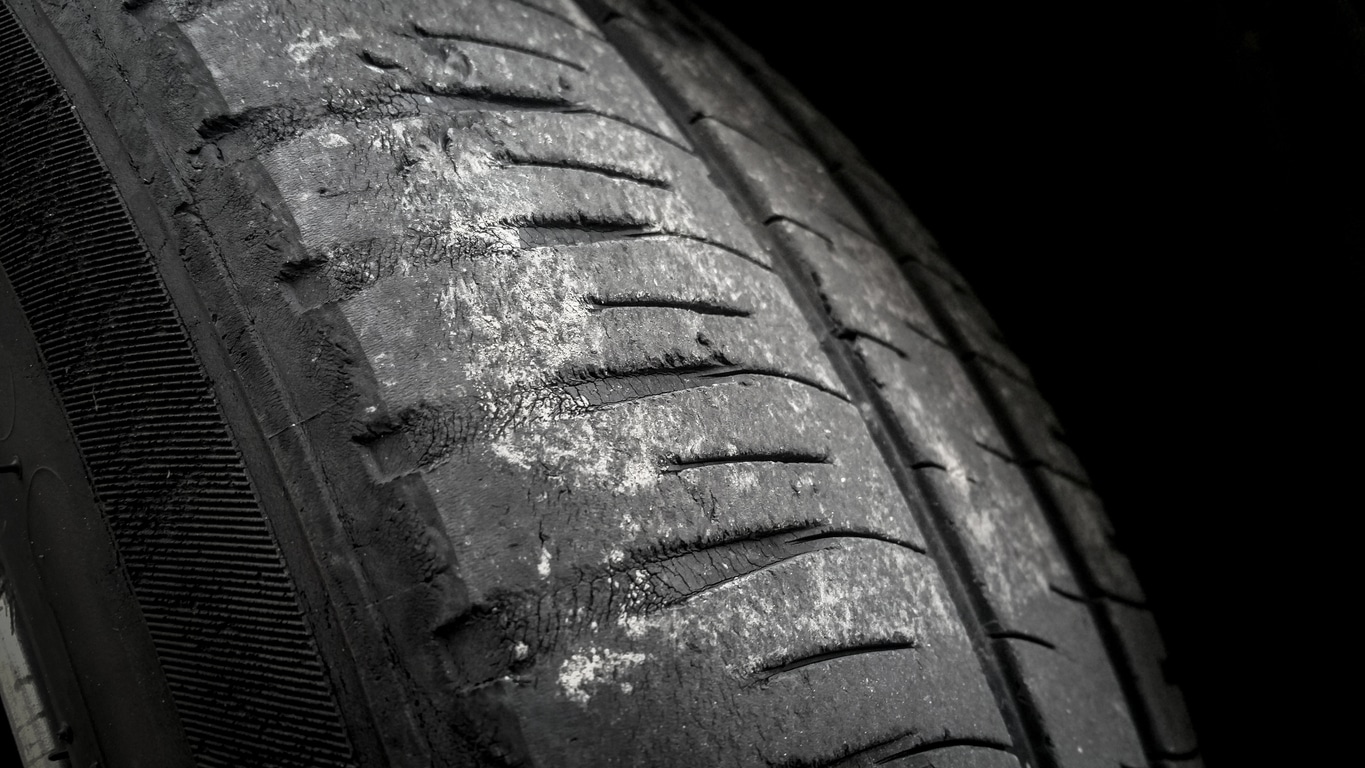
A tyre will fail an MOT if the tread depth falls below 1.6mm across the central three-quarters of the tyre around its entire circumference. Uneven wear can be a warning sign, but an MOT failure will only occur if the tread depth drops below the legal limit in this area.
Tread depth naturally decreases over time due to mileage and regular driving. However, certain factors can accelerate wear, such as harsh braking, aggressive cornering, or driving with incorrect tyre pressure. Poor road conditions, such as potholes and debris, can also contribute to tread wear, making it essential to check your tyres regularly.
2. Tyre condition
Tyres with visible cuts, bulges, or cracks on the sidewall can fail an MOT. If a puncture or damage is deep enough to expose the internal cords, the tyre will be deemed unsafe and lead to an automatic failure. Signs of perishing or excessive wear also indicate that the tyre is no longer roadworthy.
Tyre damage is often caused by driving over potholes or rough roads, which can weaken the structure of the tyre. Hitting curbs at high speed can also cause bulges or sidewall damage. Over time, tyres naturally degrade due to age and exposure to sunlight, which can lead to cracks forming on the surface.
A damaged tyre can lead to sudden deflation, increasing the risk of accidents. If a tyre is deemed unsafe, your car will fail its MOT.
3. Failed TPMS (Tyre Pressure Monitoring System)
The TPMS warns drivers when their tyres are under-inflated. A faulty TPMS could mean incorrect tyre pressure goes undetected, affecting vehicle handling and fuel efficiency.
If the TPMS warning light is illuminated or indicates a system fault, this will result in an MOT failure. For vehicles fitted with TPMS as standard, the system must be operational for the car to pass.
4. Incorrectly fitted tyres
A car can fail its MOT if it has different tyre sizes fitted on the same axle. Mixing radial and cross-ply tyres on the same axle will result in an MOT failure, as this can affect the stability and control of the vehicle. Additionally, if a tyre is incorrectly fitted to the rim, it may not function properly and could be unsafe to drive on.
Tyres fitted in the wrong direction (for directional or asymmetric designs), or tyres that rub against the bodywork or suspension, can also result in an MOT failure.

Incorrectly fitted or mismatched tyres can compromise a vehicle’s handling, braking, and stability. This makes driving unsafe and increases the risk of losing control, especially in adverse weather conditions.
5. Under-inflated tyres
Under-inflated tyres won’t automatically fail an MOT, but they can lead to issues that do.
Failing to check tyre pressure regularly is the most common reason for under-inflation. Slow punctures, valve leaks, and extreme temperature changes can also affect tyre pressure, making it important to monitor and adjust it as needed.
Under-inflated tyres not only impact handling and fuel efficiency but also cause premature wear, which may eventually lead to MOT failure.
How to prevent tyre damage in the future
Check tyre pressure regularly
Checking your tyre pressure regularly is one of the most effective ways to prevent tyre damage and ensure your vehicle remains roadworthy. It should always be set according to the manufacturer’s handbook recommendations.
Purchase good quality tyres
Investing in high-quality tyres rather than opting for cheap, part-worn alternatives can also improve durability and performance.
Drive sensibly
Driving habits also play a major role in tyre health. Avoiding curbs, potholes, and sudden braking can help preserve the condition of your tyres. Skidding around corners and aggressive acceleration can also wear tyres down faster, so driving smoothly is the way to go if you want to prolong your tyres.
Check tyre condition regularly
Inspecting your tyres frequently for sharp objects like nails, glass, or other debris can help prevent punctures. If you notice any damage, it’s best to address the issue before it worsens.
Maintaining your tyres is essential for passing your MOT and, more importantly, for your safety on the road. Regular checks can help you avoid the most common MOT tyre failure reasons.
And if you ever find yourself with a puncture, Tyreweld is here to help. Holts’ emergency tyre puncture repair solution gets you back on the road quickly – but remember, it’s only a temporary fix. Always have your tyre professionally repaired or replaced as soon as possible!