Just like a fingerprint, your car’s VIN number can tell you all sorts of information, from where it was made and who by to its engine size, safety features, body style and production number. This makes it easy to find the right parts for your car, and check that everything’s legitimate before handing over cash on the forecourt.
In this guide, we offer practical tips on how to read your car’s VIN code and what each letter and number represents.
What is a VIN Code?
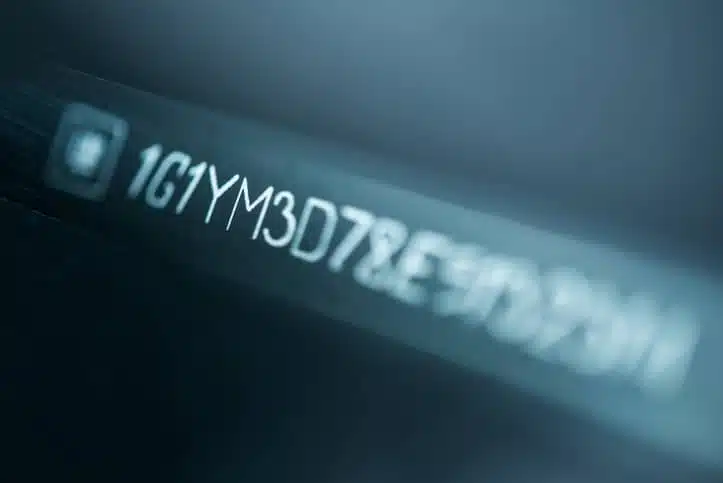
VIN codes are found on every car in the world built since 1983 and, even if cars were made on the same production line, no two VINs are ever the same. They’re made up of 17 numbers and letters which represent information about where the car was built and its exact specification, so you can find out pretty much all there is to know about a car from this unique code.
It acts a unique identifier for each car which can be useful in case of repairs, thefts or warranty claims.
Where can I find my VIN code?
There are a few places where your car’s VIN Code will be located.
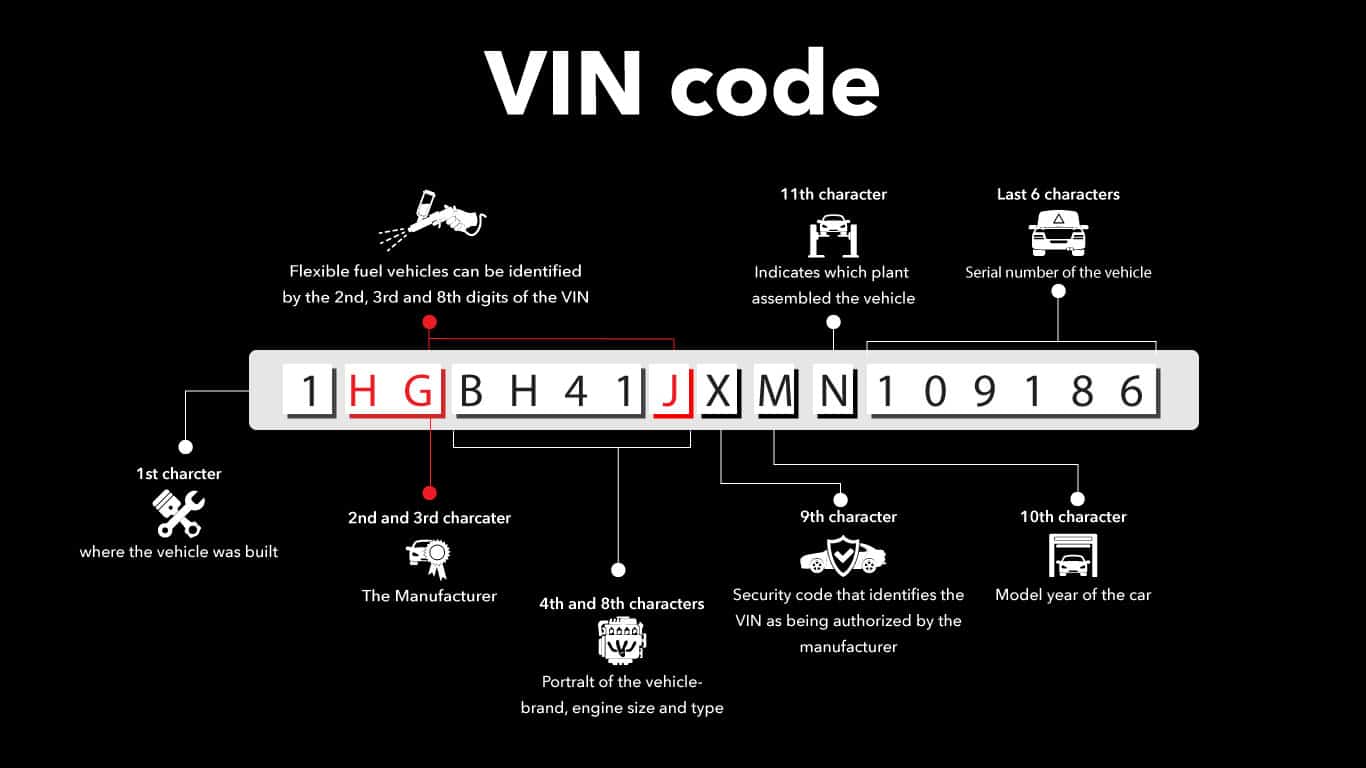
The diagram below shows examples of the kind of information you can get from your car’s VIN.
The VIN can be found in the following locations: on the dashboard, driver’s side door and on the registration certificate.
How to Read and Decode Your Car’s VIN
If you spend a lot of time under the bonnet and enjoy DIY fixes, you should find out how to read your car’s VIN. This will make it easy to find the exact parts for your car, so you can keep your faithful old motor running well for longer.
Here, we look at what each digit in a VIN code means and how it can help you find out more about your car.
First 3 Digits – World Manufacturer Identifier (WMI)
The first three digits of the VIN are classified as the WMI, and show the country of origin, manufacturer, and specific division within a manufacturer.
1st – A letter or number showing where in the world the car was built
Remember the following:
A-H – Africa
J-R – Asia
S-Z – Europe
1-5 – North America
6-7 – Australia and New Zealand
8-9 – South America
2nd – The manufacturer that made the car
A full list of manufacturers and their associated VIN codes can be found, here.
3rd – The specific division of a manufacturer that made the car
For example, Mercedes’ AMG division’s VIN is WMX.
Digits 4-8 – Vehicle Descriptor
The next five digits outline specific details about the car, including the engine size, safety features and body style.
4th – Safety features and model-specific information
The fourth digit gives details of the car’s model-specific features, such as additional safety information.
5th – The car’s series
This represents the exact series of a specific model, usually shown by a letter.
6th and 7th – The body style
Convertible, saloon or hatchback; the 6th and 7th digits show the car’s body style and type.
8th – Engine size
The eighth digit often shows the car’s engine type, especially in US manufacturers and is usually represented by a letter. However, this can differ between manufacturers and isn’t consistent across all brands in the UK and Europe, so you must look up the VIN in a database specific to your car’s manufacturer to ensure repair parts are compatible with your vehicle.
9th Digit
This is called the ‘check digit’ and is used to validate the authenticity of the car’s VIN code. Using some complex maths that we won’t bore you with here, the check number should match up with the rest of the digits in the VIN. It’s difficult to check the validity of a VIN yourself as it requires some serious maths, but an online VIN decoder should tell you if the VIN is legit.
10th Digit
The tenth digit usually shows the exact year the car was made, represented by a letter or number depending on its age. Using the table below, you can find a car’s year of manufacture through the VIN code – great if it has a personalised number plate or you want to check its validity before buying.
11th Digit
The 11th digit shows at which manufacturer plant the car was made.
Digits 12 – 17
The last six digits of the VIN code are the production line number assigned by the manufacturer. This is the part of the VIN you’re least likely to need; however, in some cases, it can help to track down a part if certain changes were made to a specific model at the time of production.
Can I find my paint code with my VIN number?
Despite the VIN number a lot of information about your car, it’s unfortunately doesn’t identify the exact colour of your car. To know the exact colour of your car, you’ll need to locate your car’s paint code.
The paint code can sometimes be found printed near the VIN number, but this isn’t certain. Other potential locations of your paint code include: inside driver’s side door, in the boot, or under the bonnet.
For more information on how to check for your paint code, check out our dedicated blog.
How do I find my car’s engine code from the VIN number?
In order to determine your car’s engine code, you must look for 2 digits within the VIN number.
The 10th digit denotes the year that the car was manufactured and the 8th digit is the engine’s code. With those two pieces of information, a professional will be able to tell you which engine you have in your car.
Understanding how to decode your car’s VIN is not only satisfying, it can help you get the parts you need to keep it running at its best. It’s also a great way to learn more about a used car before you decide to buy, including its history.
Of course, there are easier ways to decode a VIN than going through the letters and numbers yourself. There are now several VIN-decoding services online that let you find information about your car in a matter of seconds, which is great if you need to find parts or check its history on the fly.
At Holts, our DIY car maintenance tools are great for quick fixes that will get you back on the road after a flat tyre or non-starter. For more information or to browse our complete product range, visit the homepage today.